Victorian Verandah Posts in Melbourne: A Restoration Guide
Victorian verandah posts present one of heritage restoration’s most exacting challenges: one post rots through at the base, and suddenly you’re standing on the verandah staring at seven surviving originals, trying to work out where on earth you’ll find an eighth that actually matches.
It’s not just a timber problem, it’s a profile problem. Victorian verandah posts carry a specific visual language, built from turned rings, coves, beads, and decorative capitals, and no standard hardware-store post speaks that language fluently. Whether you call them Victorian verandah posts, verandah columns, or porch posts, the profile is everything.
That’s the gap Karem Woodcraft has spent years filling. Built on three generations of Australian timber craftsmanship and based in Melbourne with Australia-wide delivery, the business specialises in replicating exactly these kinds of period profiles for heritage homeowners who refuse to compromise on authenticity. Whether you need a single replacement post or a full set for a new build, the approach is the same: get the profile right, use the right timber, and protect it properly.
By the end of this guide, you’ll know how to identify the post style you’re working with, choose the right timber species, measure accurately for a replacement, protect against rot from the ground up, and make a clear decision between stock and custom sourcing.
What Makes Victorian Verandah Posts So Distinctive
The defining feature of a Victorian verandah post is its turned mid-section. Rather than a plain straight shaft, the profile carries decorative rings, coves, and beads cut on a lathe, giving the post a sculptural quality that flat or square posts simply don’t have.
This ornament was intentional. Houses built between roughly the 1850s and 1900s used verandah detailing as a visible marker of status, and the posts were a central part of that display. This is also what separates Victorian posts from Edwardian or Federation ones, which tend toward slimmer, more restrained profiles.
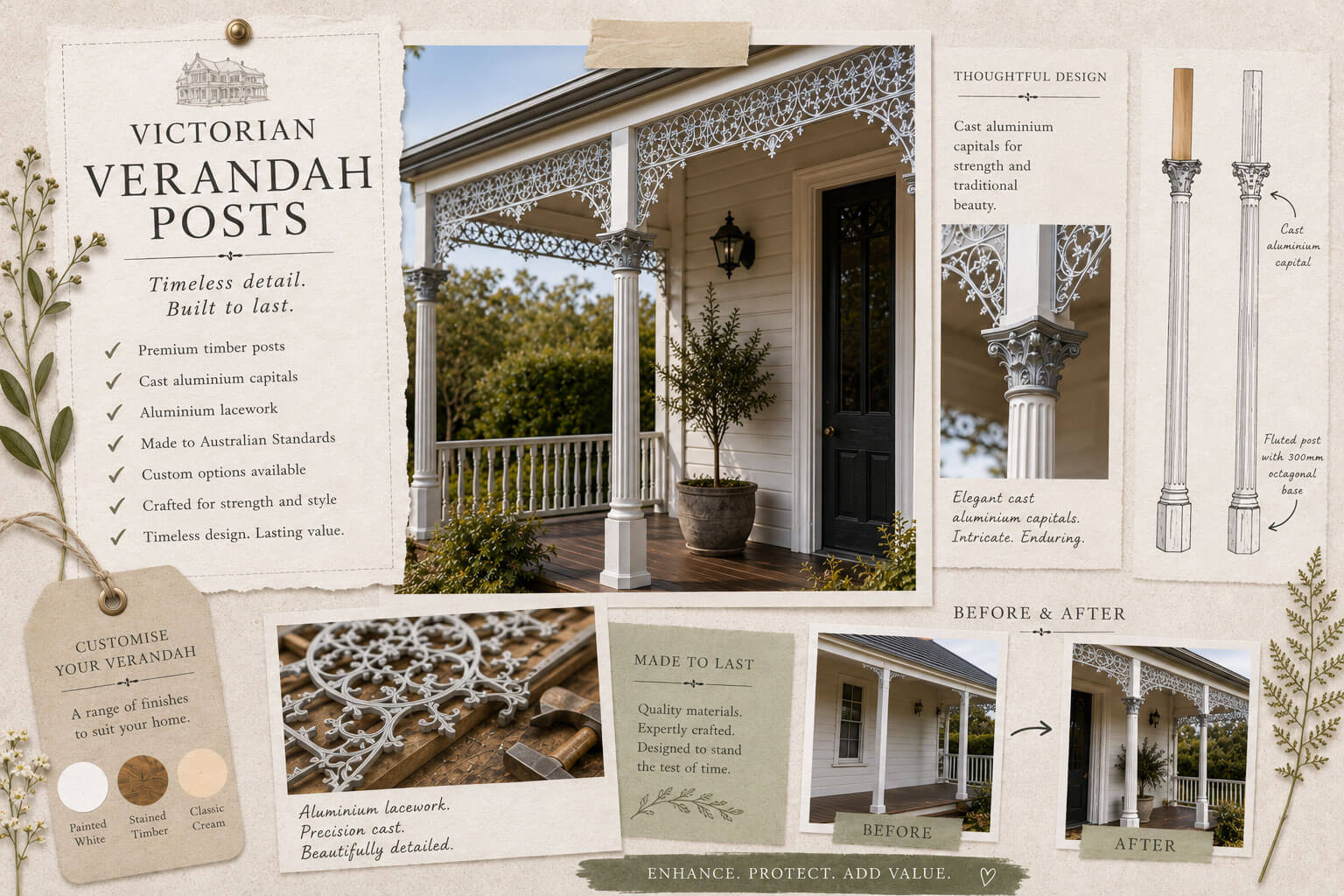
If the post in front of you has bold, layered turning with pronounced rings and a decorated capital, it’s a strong indicator you’re looking at Victorian-era work. If the profile is minimal and the shaft is close to plain, you’re likely looking at a later period style. Karem Woodcraft’s V7 turned post is a clear example of the Victorian style, carrying exactly this kind of layered turning and decorated capital.
The Anatomy of a Turned Post Profile
Every Victorian verandah post divides into three structural zones: the capital at the top, the turned shaft in the middle, and the base section at the foot. Each zone carries its own period detailing.
The capital typically features a projecting moulded head that connects to the verandah beam above, while the base section either sits on a plinth block or mounts directly to a base plate at floor level. Understanding these three zones is the foundation for accurate measurement when ordering a profile match. For examples of period-style decorative heads, see Karem’s work on post capitals.
The most common turning vocabulary along the shaft draws from classical moulding profiles: ogee curves, scotias, beads, and torus rings. These aren’t random decorations. They follow a proportional logic that gives authentic Victorian posts their visual weight and rhythm. A reproduction post that gets these proportions wrong looks noticeably off next to an original, even to an untrained eye.
Octagonal Bases, Decorative Capitals, and What to Look For
Beyond the shaft turning, two details are particularly diagnostic of Victorian-era posts. The first is an octagonal or stop-chamfered base section, where the square timber transitions to eight faces before reaching the base plate. The second is a projecting block or moulded capital at the top, which can range from a simple chamfered head to an acanthus-style or multi-profiled capital on more elaborate examples.
The turning profile along the shaft is the hardest element to replicate with an off-the-shelf product, which is why profile matching from a specialist matters so much when a single post needs replacing.
The Timbers That Defined the Victorian-Era Verandah
Victorian builders worked with whatever species were available and affordable at the time of construction. In Australia, that meant a combination of local hardwoods for structural work and softer, more workable timbers for decorative turned joinery. The result is real variation across the country: the post on a high-end Melbourne terrace and the post on a country Queensland homestead may share a profile style but come from completely different timber species.
Hardwood, Cedar, and Traditional Softwoods
Australian hardwoods are commonly used for structural applications today, and species such as ironbark, spotted gum, and tallowwood are valued for their natural durability and density. Australian red cedar was the timber of choice for high-quality turned joinery through the early to mid-Victorian period, prized for its workability, straight grain, and natural resistance to decay.
As cedar supplies tightened toward the end of the nineteenth century, Queensland kauri, hoop pine, and Baltic pine filled the gap in better-quality painted joinery work. For economy builds and painted posts, white pine and Baltic pine were standard choices. They machine well, hold paint reliably, and were affordable at scale.
Their vulnerability has always been moisture: softwoods like pine are more susceptible to rot and can fail at the base much sooner than durable hardwoods without proper maintenance and regular repainting.
Treated Pine as a Modern Reproduction Timber
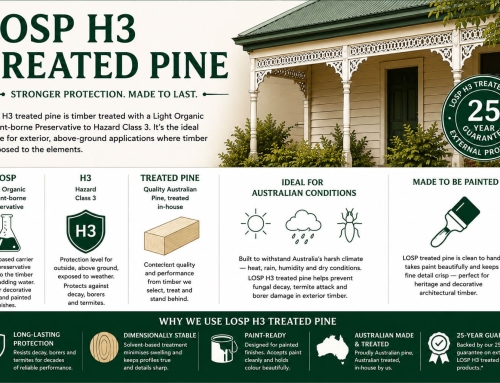
For reproduction posts today, LOSP H3 treated radiata pine is a practical and widely used choice for painted exterior applications. It machines cleanly for lathe turning, accepts paint finishes well, and with quality preservative treatment it resists the termite and fungal decay risk that ended the life of many original posts.
Karem Woodcraft offers in-house LOSP H3 treatment on pine products, so posts leave the workshop already protected before they reach site. Confirm current treatment options and specifications directly with the team when placing your order.
Standard Sizes and Measuring for a Period-Accurate Replacement
Victorian verandah posts were not built to a single national standard. Dimensions varied by builder, region, and era, so original posts on a given house may not match any stock size exactly. Getting replacement dimensions right is the difference between a seamless restoration and a post that reads as visually wrong alongside the originals.
Common Cross-Sections and Lengths
In supplier catalogues for Victorian-style turned posts, square sections typically run from 88×88 mm up to 140×140 mm, with round turned profiles ranging from 100 mm to 150 mm diameter. Standard stock lengths generally fall between 2.4 m and 4.5 m, though this varies by supplier and profile. Always confirm finished dimensions against your supplier’s sizing charts, as nominal and finished sizes differ.
Verandah height drives length selection more than any other variable. A standard single-storey verandah post is typically in the 2.4 m to 3.0 m range, while taller or two-storey verandahs push toward 3.6 m to 4.5 m. Always confirm the finished floor-to-beam height on site before ordering rather than relying on estimated figures.
How to Measure an Existing Post for Profile Matching
For a profile match, three measurements matter most:
- Ground to the top of the capital — the installed height of the post, measured from the floor to the very top of the capital.
- Overall height — the full overall height of the post.
- Thickness of the square — the dimension across a flat face of the square section, before the timber is turned round (for example 90 mm, 100 mm, or 140 mm).
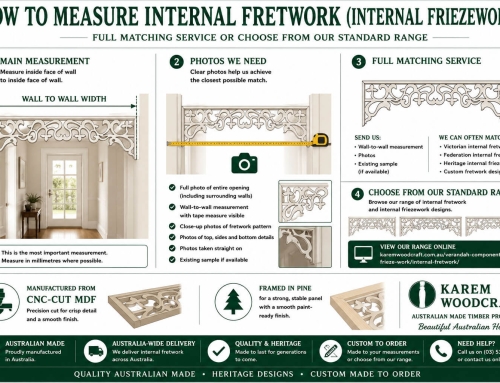
With those down, document the turning profile. Photograph the post from directly in front and from each side, and capture a close-up of the moulding details along the shaft to record the depth and spacing of each bead and cove.
Profile-match quality is only as good as the information you supply. Specialist timber turners build reproductions from these measurements and photos, so accurate, complete documentation directly determines how closely the replacement matches the originals.
Installing Posts Correctly and Stopping Rot Before It Starts
A well-made period post can last for generations with correct installation and maintenance. The post itself is rarely where failure starts. Moisture management at the base is where most rot begins, and it’s entirely preventable with the right mounting approach.
Base Plate and Anchor Options for Period Homes
Three main mounting systems suit heritage verandah applications. Surface-mount base plates install over structural blocking beneath the floor surface and are common in new construction, provided the base plate design allows water to drain rather than pool against the timber. Fascia-mount systems fix to the vertical face of the structure rather than penetrating the horizontal floor surface; this is the preferred option on any verandah with a waterproofed membrane below, as it avoids puncturing that layer entirely. Traditional plinth block bases, where the post sits on a raised timber plinth at floor level, are the most period-authentic approach and work well when the structure below is sound and dry.
In all cases, use corrosion-resistant fasteners sized for the application. Stainless steel structural screws are the standard choice for timber and composite surfaces. Galvanised hardware is acceptable, but check ratings for exposed coastal or high-humidity environments.
Keeping Timber Posts Elevated and Dry
Keep the post base slightly proud of the floor or slab surface so water doesn’t pool against the end grain. Where levelling is needed, use composite shims rather than timber shims: composite material doesn’t rot and doesn’t compress over time the way timber shims do. Ensure any flashing or sealant at the base creates a drain path rather than a moisture trap.
Repainting the base section every three to five years is one of the most effective long-term protection measures for painted posts, and a sensible part of regular exterior timber maintenance.
Sourcing Victorian Verandah Posts: Stock vs Custom
Most homeowners hit a wall at the sourcing stage. Catalogue posts from general hardware suppliers are built to generic profiles, and generic profiles don’t match the specific turning details on your surviving Victorian posts. For a restoration to read as cohesive, the replacement needs to match what’s already standing.
When Stock Posts Work and When They Don’t
Stock Victorian-style posts are a reasonable solution when you’re installing a complete new set with no existing posts to match. Several specialist timber suppliers carry pre-turned Victorian profiles in standard sizes, with short lead times from stock. The limitation is selection: you choose from what’s in the catalogue, and catalogue profiles are designed to look period-appropriate rather than to replicate any specific original.
If you’re adding a verandah to a period-style new build where authenticity to a specific house isn’t the constraint, stock posts from a reputable timber supplier are a practical and cost-effective starting point. They deliver the visual character of the era without the cost or lead time of custom turning.
Why Custom Profile Matching Is Often the Only Real Answer
When you need to match an existing post, same turning beads, same capital projection, same shaft proportions, custom turning is the only way to get there. Karem Woodcraft specialises in exactly this work: replicating existing Victorian verandah post profiles from measurements and photographs, milling replacements that sit alongside originals without a visible break in the aesthetic. See examples of the team’s heritage matching work on the Timber Verandah Posts page.
The result is a restoration that holds up to close inspection, not just a distant glance. Custom posts from a specialist typically cost more than comparable stock equivalents, and lead times are longer, so factor that window into your project schedule. That premium is real, but the alternative, a profile that reads as wrong next to the originals, undermines the entire restoration investment.
What Victorian Verandah Posts Cost
Getting a feel for the cost helps you plan your restoration budget before you start calling suppliers. As a guide, Karem Woodcraft’s turned timber verandah posts range from around $406 to $797 each, depending on the profile, the dimensions, and the timber. Simpler standard profiles sit at the lower end, while larger and more decorative posts sit toward the top.
Profile complexity, size, and timber species all move the figure, so treat these as guide prices rather than fixed quotes.
Standard Posts vs Custom Profile Matching
A standard turned profile from the range is the most cost-effective option, and it’s the right choice when you’re installing a complete new set with no existing posts to match. Availability is usually quicker, too.
Custom profile matching, replicating the exact turning, capital, and proportions of your surviving originals, is quoted individually, because dimensions, profile complexity, timber species, and treatment all affect the final number. Ordering early, before you need posts on site rather than mid-renovation, reduces the risk of schedule delays on heritage restoration projects.
Getting Your Victorian Verandah Right From the Start
Victorian verandah posts are one of the highest-visibility features on a period home. Getting the profile right protects both the look and the long-term value of a heritage property in a way that few other single elements can match. A mismatched post draws the eye precisely because it doesn’t belong; a well-matched one becomes invisible, which is exactly what a successful restoration looks like to a heritage assessor or a careful observer.
The decision path is straightforward once you have the information. Identify your profile and its three structural zones. Confirm the timber species and treatment needs for your climate and application. Measure accurately, photograph thoroughly, and decide early whether stock or custom is the right call for your situation. If you have existing Victorian verandah posts to match, custom is almost always the answer.
Karem Woodcraft is the place to start for both: see the Timber Verandah Posts range for new installations, or get in touch directly for custom profile replication from your measurements and photos. The right post exists, it just needs to be made to the right specification.
CONTACT US
Don't hesitate to get in touch with us, we would love to discuss on your order.
Phone: 1300 547 581
852 Mountain Hwy, Bayswater VIC 3153
Fax: (03) 9720 7191
Email: [email protected].