Verandah design ideas for heritage homes
Published
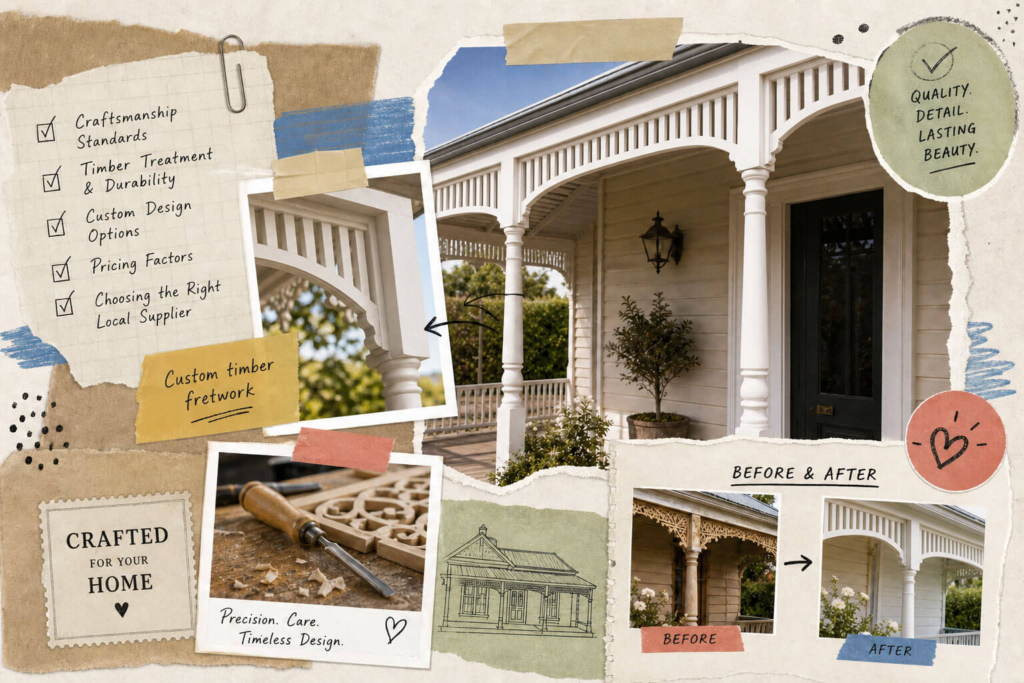
When a verandah has been patched over the years, it can be hard to tell where to start. Take a straight-on photo and look for the parts that repeat. A single original corner bracket or a sound turned post may tell you more about the verandah than a label like Victorian or Federation. The aim is to see what already belongs together before you choose what to replace.
Work from the roofline down
Take a side photo that shows the wall, the roof edge and the front beam. If you are repairing a curved roof, compare the existing profile with a bullnose rafter or Olde Gothic rafter. The curve can be hard to read from the footpath. Ask your installer to confirm the profile, timber section and dimensions before ordering, especially if you are also replacing the roof covering.
Back at the front of the house, look at where the beam lands on the posts. Compare the shape and the plain sections of the V1 turned post with another design in the verandah post range. If the roofline and post spacing are staying, the top of the post needs to make sense alongside the existing beam and brackets. For a single replacement, take close photos beside a tape measure and enquire about a made-to-match post.
Give the brackets and fretwork room
Fretwork and brackets are often chosen from separate catalogue pages, yet they share the same opening. Try laying the two outlines over a front photo. Compare a CB1 corner bracket with the FR4 arched fretwork kit, then check where their profiles would meet the post and beam. A piece that looks quite open on its own may feel busy when it repeats through every bay. Compare the widest and narrowest openings before settling on one pattern.
Decide what the lower part of the verandah needs
If the verandah has a balustrade, look at the uprights against the details above. A straightforward square profile can let a detailed bracket stand out. A turned baluster can pick up a shape in the posts. The assembled BS6 balustrade and TB4 turned baluster show two different approaches. If you are replacing a barrier, have your builder confirm the required design and fixings rather than working from the appearance alone.
Send the photos as a set
One wide photo, one side view and a few close-ups will cover most of the design conversation. Mark which parts are being kept and identify any damaged pieces that need matching. Include rough measurements for discussion and have the finished sizes checked before you order. If you need help naming what you can see, use What’s What to identify the pieces before you write the enquiry.
Talk to the workshop
Don't hesitate to get in touch with us — we would love to discuss your order. Call 03 9720 7266 or 1300 547 581, or send us the details below.